Incredibly Moist Carrot Cake Recipe (with Cream Cheese Frosting)

Intro: Ultra-moist, bakery-style carrot cake from your own oven
Saturday afternoon, rain on the windows, and I’m in the kitchen grating a ridiculous mountain of carrots while my kids argue about whose turn it is to lick the frosting bowl. The whole place smells like cinnamon and sugar, and I’m already thinking about sneaking the first slice before dinner. Worth it.
If you’ve ever baked a carrot cake that turned out dry, bland, or just “meh,” I’ve been there too. I’ve thrown out gummy layers. I’ve watched frosting slowly slide off a still-warm cake. Total disaster. That’s exactly why I built this carrot cake recipe from scratch to be ultra-moist, warmly spiced, and sturdy enough to stack into a beautiful layer cake without falling apart.
We’re talking a tender crumb that leans bakery-style: soft and plush, but not soggy. Plenty of freshly grated carrots, a good hit of cinnamon and ginger, and that rich, tangy cream cheese frosting that makes everyone go quiet for a second when they take a bite. No mixer needed for the batter, so you can absolutely pull this off on a random weeknight or right before guests show up.
And here’s the fun part: you’re in control. Love pineapple and nuts? Fold them in. Baking for raisin-haters or a nut-free classroom party? Leave them out and keep it simple. I’ll walk you through a “mix-in matrix” so you can customize without messing up the texture.
If you’re just here for the measurements and bake time, you can always Skip to Recipe. But if you want to know why we use oil instead of butter, why freshly grated carrots are non-negotiable, and how to guarantee your cake is even better the next day, hang with me for a few minutes. Your future self, standing in front of the fridge eating cold carrot cake with a fork, will be very happy.
Craving more tall, bakery-style cakes? Head over to The Ultimate Guide to Classic Layer Cakes for step-by-step stacking tips, crumb coat secrets, and seven must-bake classics.
Why This Is The Only Carrot Cake Recipe You Need
You know how every family has that one “house dessert” that shows up at every birthday, potluck, and random Tuesday? This is that cake. It’s the one I bring when I really do not want to come home with leftovers, and somehow the plate still comes back with just crumbs and a smear of cream cheese.
100% oil-based for maximum moisture
Let’s start with the big one: fat. Butter tastes amazing, but in a carrot cake it firms up as it cools, which can make the crumb feel a little drier the next day. Oil stays liquid at room temperature, so the texture stays moist and plush for days. Actual days.
Using all oil means you get that velvety, tender bite every single time, even straight from the fridge. I’ve tried the half-butter, half-oil approach, and honestly, it never quite beat this fully oil-based version. And we save the butter for where it really shines: in the frosting.
The tender-but-structured crumb (not soggy, not dry)
Some versions of this classic either crumble into dry little carrot-flavored dust, or swing the other way and end up heavy and wet. Neither is fun. This batter hits the sweet spot by using the right ratio of flour to oil to freshly grated carrots, plus just enough egg for structure.
You get a cake that slices cleanly, stacks beautifully, and still feels soft when you press it lightly with a fingertip. No weird rubbery edges. No sad, dry center. Just a tight, even crumb that feels bakery-level, without the stress of bakery-level equipment. My sister, who usually peels off frosting and leaves half the slice, actually finishes her whole piece with this one. That says a lot.
Better-next-day flavor (the spice “aging” effect)
Here’s the secret superpower of this carrot cake recipe: it’s even better on day two. The warm spices and brown sugar have time to mingle and melt into each other, so the flavor deepens and rounds out. It’s like soup that tastes better after sitting overnight. Same idea.
So if you’re baking for a holiday, birthday, or brunch, you can make the layers the day before, wrap them up, and then frost the next morning. Low stress. Big payoff. And if you’ve ever opened the fridge at 10 p.m. and taken a fork straight to a leftover slice, you already know how magical “next day cake” can be.
The flexible mix-in system (you choose nuts, raisins, pineapple)
Now for the fun part. People have strong opinions about what belongs in homemade carrot cake. Nuts or no nuts. Raisins are loved or hated. Pineapple is genius or “absolutely not.” Instead of forcing you into one camp, this recipe gives you a simple formula so you can decide.
You start with a base batter that is perfectly balanced on its own. Then you add up to a set amount of mix-ins without throwing off the texture. Toasted pecans, chopped walnuts, raisins, or a bit of well-drained crushed pineapple all work. Or nothing at all. And because the structure is already solid, your choices stay safely in the “personal preference” zone, not the “hope this doesn’t ruin my cake” zone.
Key Ingredients & Substitutions
When you look at the ingredient list, nothing seems wild. Flour, sugar, oil, eggs, spices. Pretty normal. The magic is in how each one is chosen and how they all play together so you get that moist, tender crumb instead of a dry, bready situation.
Carrots: why freshly grated is non-negotiable
Let’s start with the star. You absolutely need to grate your own carrots. Pre-shredded bagged ones are dry, tough, and often coated in additives to keep them from clumping. They just sit in the batter and never really melt in, which is how you end up with dry cake and weird chewy bits.
Grab whole carrots, peel them, and use the large holes of a box grater or a food processor shredding disc. You want fluffy, slightly juicy shreds, not big chunky pieces. I usually throw a clean kitchen towel under the grater because I always manage to fling carrot bits halfway across the counter. Every time.
If you’re measuring by cups, don’t pack them down hard. Lightly scoop the grated carrots into the cup so you keep the moisture balanced.
Sugars: brown + white for moisture and structure
Using a mix of granulated sugar and brown sugar gives you the best of both worlds. White sugar helps with structure and sweetness, while brown sugar brings moisture and a subtle molasses depth that just fits with the warm spices.
If you’re ever tempted to swap it all for white sugar, the cake will still work, but you’ll lose some of that deep, almost caramel-like flavor. Going all brown sugar makes things a little heavier. The blend is the sweet spot.
Fats: neutral oil and an optional applesauce swap
We’re using a neutral oil like canola, vegetable, or a light-tasting olive oil. Nothing strongly flavored. The goal is moisture without distracting from the spices and carrots.
If you want to lighten it just a bit, you can swap out a small portion of the oil for unsweetened applesauce. I like doing this when I know we’ll be eating it for breakfast the next day. Just don’t replace all the oil or you’ll start to lose that soft, plush texture.
Warm spices: cinnamon, ginger, nutmeg
The spice trio is what makes your kitchen smell like heaven. Cinnamon is the main flavor, ginger adds a gentle warmth that sneaks up on you, and nutmeg fills in the background.
If you love a heavily spiced cake, you can nudge the cinnamon up a little, but don’t go too wild or it will overpower the carrot and vanilla. I once dumped in “a little extra” without measuring and ended up with something that tasted like a gingerbread experiment. Still good, but not what I wanted.
Mix-ins: nuts, raisins, pineapple or none at all
This is where you get to play. Chopped pecans or walnuts bring crunch and that toasty, nutty flavor. Raisins add little soft, sweet pops. A bit of well-drained crushed pineapple makes things extra juicy and bright.
The important thing is not to go over the total amount of mix-ins, or you’ll weigh down the batter. Stick to the suggested quantity and mix-and-match within that limit. Or skip everything if your crowd is picky. The base cake is strong enough to stand on its own.
Room temperature ingredients
A quick but important note. For the best texture, your eggs should be at room temperature so they whisk smoothly into the oil and sugar. Cold eggs can make the batter curdle-looking and harder to mix evenly.
And for the frosting, brick-style cream cheese and butter absolutely need to be soft before you start. Cold ingredients equal lumpy frosting. I usually set them out on the counter while I grate the carrots and make the batter, and by the time the layers are baked and cooled, they’re ready to whip into that fluffy, tangy cloud that belongs on top of this carrot cake recipe.
Step-by-Step: How To Make Moist Carrot Cake
The nice thing about this batter is that it’s totally low-drama. Two bowls, a whisk, a spatula, and you’re in business. I’ll walk you through the flow I use every single time so you’re not second-guessing anything.
Step 1: Prep pans, line with parchment, and grate the carrots
First things first: preheat your oven to 350°F (175°C). Lightly grease two 9-inch round cake pans, then line the bottoms with circles of parchment paper and grease the parchment too. This feels extra, but it’s the difference between cake layers that pop right out and cake layers that need to be excavated with a knife.
Now grate the carrots. Peel them, then use the large holes of a box grater. You want soft, fluffy shreds, not big chunks. By the time you’re done, you’ll have a little orange snowdrift on the cutting board and probably one carrot shred stuck to your sleeve. Totally normal.
Step 2: Whisk the dry ingredients
In a medium bowl, whisk together the flour, baking soda, salt, and all the warm spices until everything looks evenly blended with no streaks. This is where you prevent spice “hot spots” so one bite doesn’t taste like pure cinnamon.
Set this bowl aside. It’ll wait for you.
Step 3: Whisk the wet ingredients (no mixer needed)
In a large mixing bowl, add the oil, granulated sugar, brown sugar, and vanilla. Whisk until the mixture looks thick and glossy. It won’t be totally smooth yet, but it should look well combined.
Add the eggs one at a time, whisking well after each. The mixture will go from heavy and grainy to smoother and a little ribbony. If your arm gets tired, you’re doing it right. I usually switch hands halfway through.
Step 4: The two-bowl method (combining wet & dry without overmixing)
Sprinkle the dry ingredient mixture over the wet ingredients. Switch to a rubber spatula and gently fold, sweeping around the bowl and cutting through the center. You want to stop as soon as you don’t see dry flour pockets.
If you keep going past that point, the gluten in the flour develops and your cake can turn tough. So as soon as the batter looks mostly uniform, walk away. Seriously. Put the spatula down for a second.
Step 5: Fold in carrots and mix-ins
Add the grated carrots to the bowl and gently fold them in until they’re evenly distributed. The batter will look thick and nicely speckled.
If you’re using nuts, raisins, or pineapple, fold them in now too. Make sure any pineapple is well drained so you’re not sneaking extra liquid into the batter. You should still see plenty of batter around the mix-ins, not a bowl overstuffed with “bits.”
Step 6: Bake, test for doneness, and cool completely
Divide the batter evenly between the prepared pans, smoothing the tops with your spatula. I usually give each pan a gentle tap on the counter to pop any big air bubbles.
Bake on the center rack for about 35 to 45 minutes, until the tops are set and a toothpick inserted in the center comes out mostly clean, with a few moist crumbs but no wet batter. The cakes should spring back lightly when you tap the center with a fingertip.
Let the layers cool in the pans for about 15 minutes, then run a thin knife around the edges, flip them out onto a wire rack, peel off the parchment, and let them cool completely. No shortcuts here. If the cake is even a little warm when you frost it, that cream cheese frosting will slide right off in slow motion, and you’ll be staring at a delicious but messy situation.
The Best Cream Cheese Frosting
Let’s be honest. You can bake the most perfect spiced cake in the world, but if the frosting is thin, lumpy, or way too sweet, the whole thing suffers. This cream cheese frosting is thick, fluffy, and just tangy enough to balance the sweet, spiced layers underneath.
Why block cream cheese is non-negotiable
You need full-fat, brick-style cream cheese. The kind wrapped in foil. The tub stuff is formulated to be soft and spreadable, which also means it’s looser and holds more water. That extra moisture turns frosting into a runny situation that slides off the sides of your cake.
Bring the cream cheese to room temperature so it’s soft when you press it with your fingertip. Same for the butter. If either is still cold in the middle, you’ll end up with tiny lumps that refuse to smooth out, no matter how hard you beat. I’ve tried to “save” a batch like that before. Didn’t work. I just ended up with bumpy frosting and a bad mood.
How to make a smooth, pipeable cream cheese frosting
Start by beating the softened cream cheese and butter together until completely smooth and creamy, about 2 minutes. Use a hand mixer or stand mixer here; this is where you want power. Scrape the bowl and beat again so there are zero little clumps hiding along the edges.
Next, sift or whisk your powdered sugar to break up any big lumps. Add it in gradually, a cup at a time, mixing on low at first so it doesn’t puff everywhere, then a bit higher until it’s fully incorporated. The frosting will go from loose to thick and cloud-like as you go.
Beat in the vanilla and a small pinch of salt at the end. Taste and tweak. If it feels too loose for your liking, you can add a bit more powdered sugar. If it’s a little too sweet, that tiny pinch of extra salt usually fixes it.
You’re aiming for frosting that holds soft peaks on a spoon. Not stiff like buttercream, but definitely not runny.
Frosting and assembling the carrot cake layers
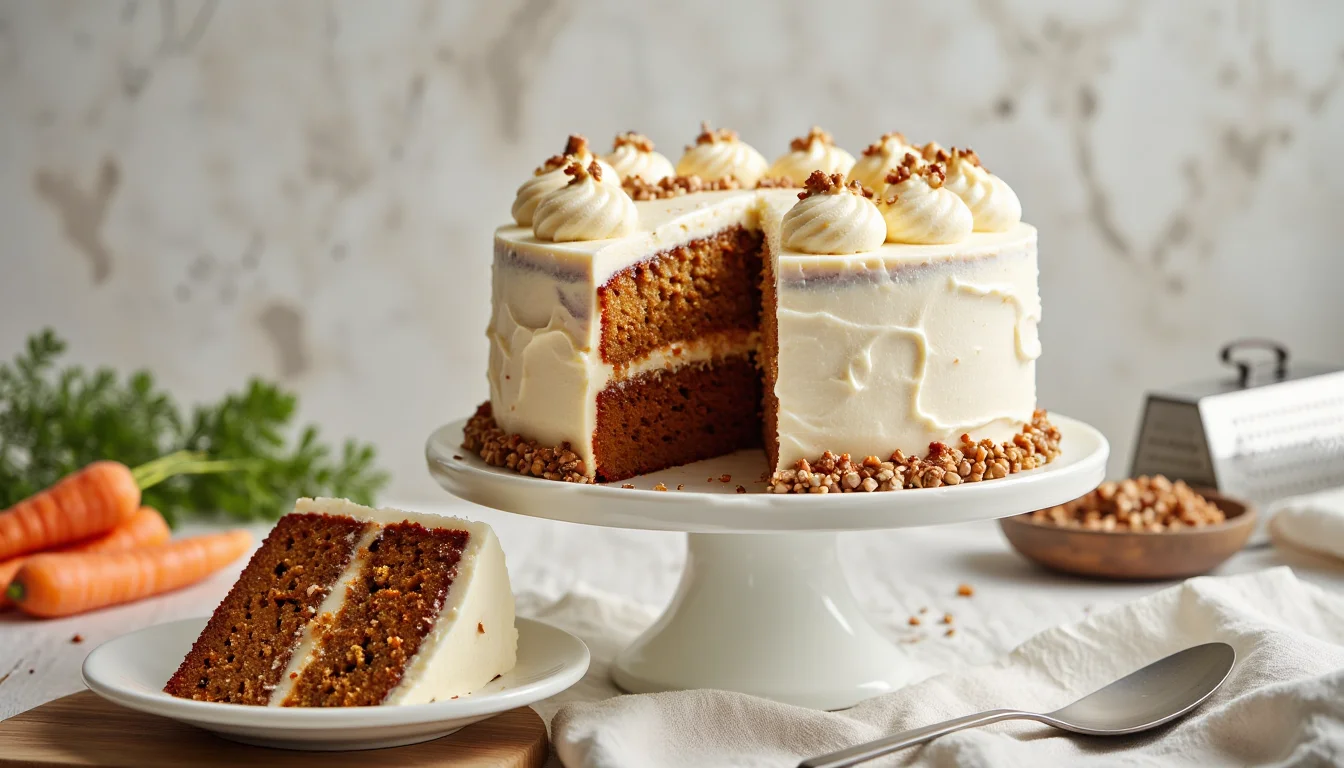
Make sure your cake layers are completely cool. I like to chill them for 20–30 minutes so they’re a bit firmer and easier to handle. Place one layer on your serving plate or cake stand, top side up.
Spread a generous layer of frosting over the first cake, pushing it gently out toward the edges. Set the second layer on top, bottom side up this time so you get a perfectly flat top. A little wobble is normal; you can nudge it into place.
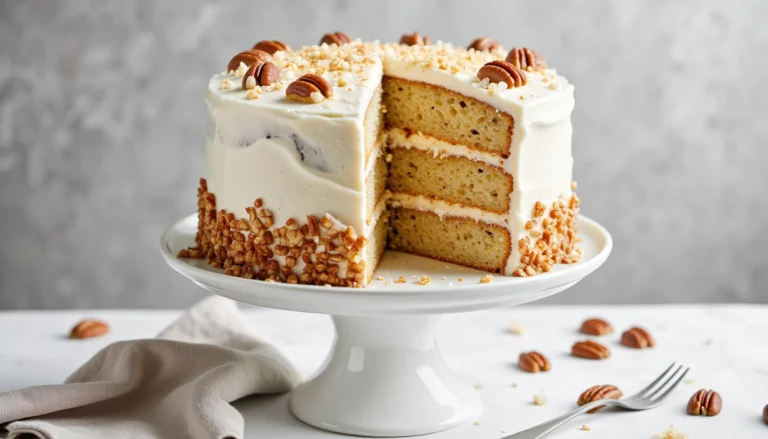
Do a thin “crumb coat” over the top and sides, scraping off most of the excess. This locks in any loose crumbs. Pop the cake into the fridge for 15–20 minutes, then come back with the rest of the frosting and swoop it on thick. If you’re using chopped nuts on the sides or top, press them on now, while the frosting is still soft and welcoming.
The Mix-In Matrix (Customize Your Carrot Cake)
Everyone has That One Opinion about what belongs inside a slice. My neighbor will fight you over raisins. My mom wants all the nuts. My kids want “just cake, please.” This system keeps everyone happy without wrecking the texture.
How much pineapple, nuts, or raisins to add
Think of your batter like a base formula. It’s perfectly balanced on its own, and you get to add up to about 1 to 1 ½ cups total of mix-ins without making it heavy.
Here’s an easy guide:
- Up to 1 cup chopped nuts (pecans or walnuts)
- Up to ½ cup raisins
- Up to ½ cup well-drained crushed pineapple
You can combine them, just keep the total around that 1 to 1 ½ cup mark. For example:
- ½ cup toasted pecans + ½ cup raisins
- ½ cup toasted walnuts + ½ cup pineapple
- ½ cup raisins + ¼ cup pineapple + ¼ cup nuts
If you go too far over, the cake can bake up dense and take forever to cook in the center. I learned that the hard way trying to “use up the rest of the bag” of nuts. The flavor was great, but the middle was a little too wet.
Pro tip: Toast the nuts in a dry skillet or on a baking sheet at 350°F for about 5 minutes, just until fragrant. Let them cool before folding them into the batter. The flavor upgrade is huge.
When to skip mix-ins (for picky eaters or nut-free homes)
If you’re baking for a classroom, a church potluck, or anyone with nut allergies, you can absolutely leave everything out and keep it pure. The grated carrots and warm spices carry the flavor, so you are not losing anything by skipping nuts or raisins.
For a nut-free crowd, you can lean on pineapple or raisins for extra interest. Or just let the super moist crumb and that cream cheese frosting do the talking. A plain-looking slice that tastes incredible is always better than a “loaded” cake that half the room can’t eat.
Quick guide: cupcakes vs layer cake with mix-ins
If you’re turning this into cupcakes, keep the mix-ins on the lighter side so they bake evenly and don’t sink. I usually do:
- ½ cup nuts total, or
- ½ cup raisins, or
- No pineapple for cupcakes
For the full layer version of this carrot cake recipe, you can safely use the higher end of the mix-in range. Just remember to fold them in gently at the very end so they stay suspended in the batter instead of all diving to the bottom.
How To Keep Carrot Cake Moist
If you’ve ever pulled a gorgeous pan out of the oven only to cut into it later and find a dry crumb, it hurts a little. Especially when you’ve used four eggs and a pile of carrots. The good news: once you understand a few core rules, keeping this cake moist is actually pretty simple.
Is it better to use butter or oil in carrot cake?
Short answer: oil wins. Every time.
Butter is delicious, but it’s solid at room temperature. That means a butter-based cake tends to firm up and feel drier as it sits, especially on day two and three.
Oil stays liquid, so it keeps the crumb tender and plush even after chilling. It also plays really nicely with all the moisture from the grated carrots and brown sugar. You get a slice that still feels soft when you press it lightly, not crumbly or stiff.
If you miss the flavor of butter, don’t worry. You’re getting plenty of that rich, buttery vibe in the cream cheese frosting, where butter can shine without messing with the texture of the cake itself.
Can I use store-bought shredded carrots?
I love a shortcut as much as anyone, but this is not the place. Bagged shredded carrots are dry, firm, and often a little woody. They’re designed to hold their shape in salads, not melt into a tender crumb.
When you use them, they don’t release enough moisture into the batter, so the cake can come out drier and more uneven. You also end up with those long, squeaky strips in every bite. Not fun.
Hand-grating whole carrots gives you softer, juicier shreds that fold into the batter and actually help keep it moist. It takes a few extra minutes, but it’s honestly one of the biggest “this tastes like a bakery cake” upgrades you can make. I’ve tried it both ways on busy weeknights. The fresh-grated version wins so hard it’s not even close.
Why this cake tastes even better the next day
Here’s the part that feels like magic. Once the baked layers cool and rest, a few things happen:
- The oil and carrot moisture redistribute through the crumb.
- The spices mellow and blend, so you taste warm spice, not just “cinnamon.”
- The frosting gently hydrates the top layer of the cake.
All of that makes each slice taste more cohesive and even softer the second day. So if you can, bake the layers ahead, cool them completely, and either wrap them well to frost later or frost the whole cake and chill it.
And when you sneak into the kitchen the next morning and cut a cold, thick slice for “quality control”? You’ll see exactly why giving this cake some time to rest is part of what keeps it so moist.
Troubleshooting Common Carrot Cake Problems
Even with a solid recipe, things happen. Ovens run hot, flour gets packed, someone opens the oven door three times to peek. I’ve done all of it. Let’s walk through the big problems and how to fix them so your next batch comes out just right.
Why is my carrot cake dry?
Dry carrot cake usually comes down to one of three things:
- Too much flour
- Not enough moisture
- Overbaking
If you’re scooping flour straight from the bag with your cup, you’re probably packing in more than the recipe expects. Instead, fluff the flour with a spoon, lightly spoon it into the measuring cup, and level it off with a knife. Or weigh it if you have a scale.
Overbaking is the other big culprit. Start checking a few minutes before you think it will be done. The top should spring back gently when tapped, and a toothpick should come out with just a few moist crumbs. If it’s coming out totally dry, it has already gone a little too far.
Also, make sure you’re using the full amount of oil and freshly grated carrots. Skimping here or using pre-shredded carrots can steal a lot of moisture.
Why did my carrots turn green?
Green or bluish carrots in a carrot cake look alarming, but it’s actually a harmless reaction. It usually happens when baking soda is not evenly mixed or the batter is very alkaline in one spot. The pigments in the carrots react to that higher pH and change color.
To avoid it, whisk your dry ingredients really well so the baking soda is fully distributed, and make sure you fold the batter evenly before adding the carrots. Then fold in the carrots gently but thoroughly so they are surrounded by batter, not clumped.
If it happens once, don’t panic. The cake is still safe to eat. It just looks like it tried a new hair color.
Why is my cake dense, gummy, or sunk in the middle?
A dense or gummy carrot cake usually means the batter was overmixed or there was too much moisture or leavening fighting against itself.
A few things to watch:
- Mix the wet and dry ingredients just until the flour disappears. No more.
- Measure the oil and any mix-ins carefully so you are not overloading the batter.
- Make sure your baking soda is fresh. Old leavening can cause poor rise, while too much can make it rise fast and then collapse.
Sinking in the middle can also happen if the cake is underbaked in the center when you pull it out. If the edges look done but the center still jiggles, give it a few more minutes. And try not to open the oven door over and over. I know it smells amazing, but that sudden rush of cool air can interrupt the rise.
Storage, Freezing & Make-Ahead Tips
Once you’ve got this beauty frosted, the next question is always the same: where does it live now? Counter? Fridge? Can I hide a slice in the freezer for future me? Let’s make it easy.
Does carrot cake need to be refrigerated?
Because of the cream cheese frosting, yes, this cake should be stored in the fridge after a couple of hours at room temperature. Cream cheese is perishable, and we want you enjoying dessert, not worrying about it.
What I usually do: let the freshly frosted cake sit at room temperature for about an hour so everything settles and softens, then cover it lightly (a cake dome or an upside-down large bowl works if you don’t have a carrier) and move it to the fridge.
Before serving, pull it out 20–30 minutes ahead so the frosting and crumb can soften slightly. Cold cake straight from the fridge is still pretty great, but a little warm-up time makes the texture dreamy.
How long it keeps at room temp vs fridge
If your kitchen is cool, the frosted cake can safely sit out for a short party window, about 2 hours on the counter while everyone goes back for “just one more sliver.” After that, back into the fridge it goes.
In the refrigerator, well-covered carrot cake stays moist and tasty for about 4 to 5 days. I like to press a piece of parchment or plastic wrap gently against any exposed cut edges to keep them from drying out.
Can I freeze carrot cake with cream cheese frosting?
Yes, you can absolutely freeze it, even fully frosted. That’s one of the reasons I love this dessert for holidays. Make it ahead, freeze, and cross one big thing off your list.
For whole cakes: chill the frosted cake in the fridge until the frosting is firm, then wrap it in a layer of plastic wrap and a layer of foil. Freeze for up to 2 months.
For slices: place slices on a parchment-lined baking sheet to firm up, then wrap each piece individually. Future you, standing at the freezer in pajamas, will be very pleased.
To thaw, unwrap the cake and let it sit in the fridge overnight. Then bring it to room temp for 20–30 minutes before serving so the crumb and frosting both relax back to their soft, moist, bakery-style selves.
Recipe Variations
Once you’ve nailed the classic version, it’s hard not to immediately start thinking, “Okay but what if this was cupcakes?” Same. The good news is you can reuse this exact batter and just tweak the pan and bake time, so you’re not relearning a whole new recipe every time.
Carrot cake cupcakes: baking time and pan changes
For cupcakes, line a standard 12-cup muffin pan with paper liners. Fill each liner about two-thirds full so they have room to rise without overflowing. If you have extra batter, bake a second partial pan rather than overfilling.
Bake at 350°F (175°C) for about 18 to 22 minutes. Start checking early: the tops should spring back lightly and a toothpick in the center should come out with a few moist crumbs. They can go from perfect to a little dry pretty fast, so don’t wander too far. I learned that while “just switching the laundry.”
Cool the cupcakes completely on a wire rack before frosting. This batch makes nicely domed, soft cupcakes that hold a swirl of cream cheese frosting like champs. For cupcakes, I like to keep mix-ins light (or skip pineapple) so they bake evenly and don’t sink.
Carrot sheet cake (9×13): pan prep and bake time
If you’re feeding a crowd or bringing dessert to school or church, a 9×13-inch pan is your best friend. Grease the pan well and line the bottom with parchment if you want easy, clean slices.
Pour all the batter into the pan, spread it into an even layer, and bake at 350°F (175°C) for about 35 to 45 minutes. The center should be set and springy, and that toothpick should come out with just a few crumbs.
Let the cake cool completely right in the pan, then spread the frosting over the top in big swoops. It’s low-effort, easy to transport, and you can cut as many little or giant squares as you want.
Simple tweaks: no nuts, no raisins, extra spice
If your crew is picky, you can completely leave out nuts and raisins and keep this as a straight, ultra-moist carrot tray cake. It still tastes amazing.
If you love a bolder spice profile, you can gently bump the cinnamon and ginger up a touch, just don’t double everything or it starts drifting into gingerbread territory. And if you ever want to lean into breakfast vibes, you can use a small portion of applesauce in place of some oil and bake it as a sheet cake. Coffee in one hand, fork in the other. No regrets.
Carrot Cake Printable Recipe Card
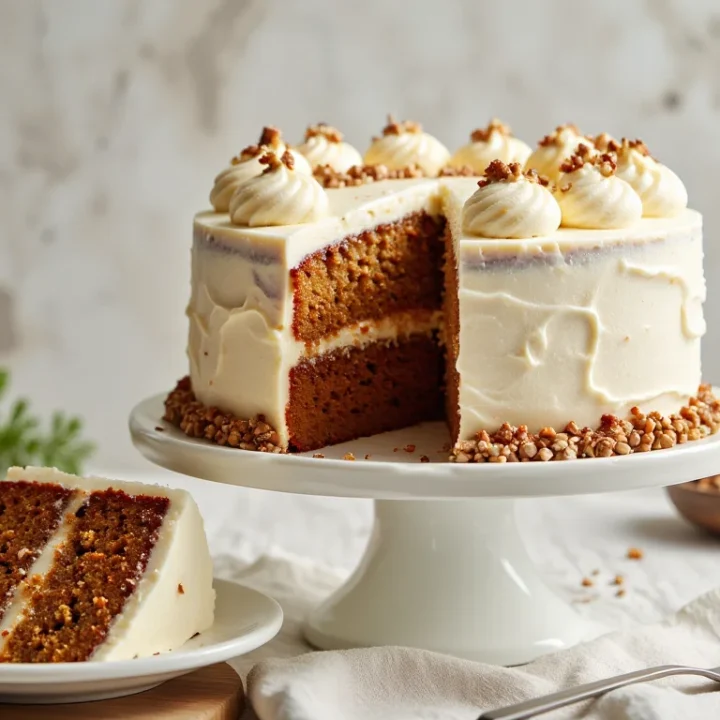
The Best Moist Carrot Cake with Cream Cheese Frosting
This ultra-moist carrot cake is packed with freshly grated carrots, warm spices, and a flexible mix-in system, then finished with thick, tangy cream cheese frosting. No mixer needed for the batter and it tastes even better the next day.
Ingredients
For the Carrot Cake:
- 2 cups (250 g) all-purpose flour
- 2 teaspoons baking soda
- 1/2 teaspoon fine sea salt
- 1 1/2 teaspoons ground cinnamon
- 1 teaspoon ground ginger
- 1/4 teaspoon ground nutmeg
- 1 1/4 cups (295 ml) neutral oil (canola, vegetable, or light olive oil)
- 1 cup (200 g) granulated sugar
- 1 cup (200 g) packed light or dark brown sugar
- 1 teaspoon vanilla extract
- 4 large eggs, at room temperature
- 3 cups (300 g) freshly grated carrots (about 5 to 6 medium carrots, grated on the large holes)
- Optional Mix-Ins (choose up to 1 to 1 1/2 cups total):
- Up to 1 cup (100 g) chopped pecans or walnuts, toasted and cooled
- Up to 1/2 cup (65 g) raisins
- Up to 1/2 cup (65 g) well-drained crushed pineapple
For the Cream Cheese Frosting:
- 8 ounces (225 g) brick-style cream cheese, softened to room temperature
- 1/2 cup (115 g) unsalted butter, softened to room temperature
- 3 cups (360 g) powdered sugar, sifted if lumpy
- 1 teaspoon vanilla extract
- Pinch of fine sea salt
Instructions
- Preheat the oven to 350°F (175°C), grease two 9-inch round cake pans, line the bottoms with parchment circles, and grease the parchment.
- Peel and grate the carrots on the large holes of a box grater or with a food processor shredding disc, then lightly measure out 3 cups (300 g) and set aside.
- In a medium bowl, whisk together the flour, baking soda, salt, cinnamon, ginger, and nutmeg until the spices are evenly distributed.
- In a large mixing bowl, whisk the oil, granulated sugar, brown sugar, and vanilla together until the mixture looks thick and glossy.
- Whisk in the eggs one at a time, mixing well after each addition until the batter looks smooth and slightly ribbony.
- Sprinkle the dry ingredients over the wet ingredients and gently fold with a rubber spatula just until you no longer see dry flour.
- Fold in the grated carrots and any optional mix-ins, such as nuts, raisins, or drained crushed pineapple, until they are evenly distributed.
- Divide the batter evenly between the prepared pans, smooth the tops, and tap each pan gently on the counter to release large air bubbles.
- Bake the cakes on the center rack for 35 to 45 minutes, until the tops are set, the centers spring back when lightly pressed, and a toothpick comes out with a few moist crumbs.
- Cool the cakes in the pans for about 15 minutes, then loosen the edges with a knife, invert onto a wire rack, peel off the parchment, and let cool completely.
- To make the frosting, beat the softened cream cheese and butter together until completely smooth and creamy, stopping to scrape the bowl as needed.
- Gradually add the powdered sugar, mixing on low at first and then on medium until the frosting is thick and fluffy, then beat in the vanilla and a pinch of salt.
- Place one cooled cake layer on a serving plate, spread a generous layer of cream cheese frosting over the top, and gently set the second layer on top.
- Cover the cake with a thin crumb coat of frosting, chill briefly to set, then finish with a thicker layer of frosting and decorate with chopped nuts if desired.
Notes
- Use only freshly grated carrots for this recipe; pre-shredded bagged carrots are too dry and will not soften properly in the batter.
- Make sure the eggs, cream cheese, and butter are at room temperature so they incorporate smoothly and give you a tender crumb and lump-free frosting.
- To toast nuts, spread them on a baking sheet and bake at 350°F for about 5 minutes or until fragrant, then cool completely before chopping and adding to the batter.
- For a slightly lighter version, you can replace up to 1/4 cup (60 ml) of the oil with unsweetened applesauce without losing the cake’s moist, tender texture.
- This cake tastes even better the next day; you can bake the layers a day ahead, wrap them tightly once cool, and frost them the following day.
- Store the frosted cake covered in the refrigerator for 4 to 5 days; let it sit at room temperature for 20 to 30 minutes before serving for the best texture.
- For cupcakes, fill lined muffin cups about two-thirds full and bake at 350°F (175°C) for 18 to 22 minutes, then cool completely before frosting.
- For a 9x13-inch sheet cake, pour all the batter into a greased and parchment-lined pan and bake at 350°F (175°C) for 35 to 45 minutes, then cool and frost in the pan.
- You can freeze the frosted cake or individual slices by chilling until firm, wrapping well, and freezing for up to 2 months; thaw overnight in the fridge before serving.
- If the frosting seems too soft after mixing, chill it for 10 to 15 minutes to firm up slightly before spreading on the cake.
Nutrition Information:
Yield: 12 Serving Size: 1 sliceAmount Per Serving: Calories: 550Total Fat: 30gSaturated Fat: 8gCarbohydrates: 68gSugar: 49gProtein: 6g
Nutrition values are estimates and will vary based on ingredients and brands.
Frequently Asked Questions (FAQ)
Love This Recipe? Discover More Classic Layer Cake Favorites
If this layer cake hit the spot, don’t miss The Ultimate Guide to Classic Layer Cakes where you’ll find more timeless flavors, smart frosting pairings, and easy fixes for every leaning, crumbly slice.